Wednesday, June 28, 2006

Take that!

As guilty as this makes me feel, I cannot suppress the feeling of schadenfreude at the news that Harvard will be suffering consequences for the indecorous defenestration of Larry Summers. Truly a victory against tyrants. Here's the story as reported by the Financial Times:
Larry Ellison, chief executive of Oracle, the business software group, has decided against a promised $115m donation to establish a centre for the study of health care projects at Harvard University.
The decision marks the first concrete fallout from the resignation earlier this year of Larry Summers, Harvard’s president, following a faculty revolt.
An Oracle spokesman said on Tuesday that Mr Ellison's decision to withdraw his pledge was "directly related" to the departure of Mr Summers, the controversial former US treasury secretary, whose brusque management style frequently clashed with members of the Harvard faculty.
"Larry Summers was the brainchild of this initiative. He and Larry Ellison had several dicussions about it. His last day at Harvard is this week, and his departure from Harvard is really the reason that Larry decided to reconsider the decision," the spokesman said.
He said Mr Ellison planned to announce a donation to another organisation within "several weeks."
Revenge is a dish best served cold!

Thursday, June 22, 2006

CND: Iran can have nukes, but not the UK

David T. (Tate) of Harry's Place has a post up in Comment is Free in which he notes an interesting double standard:
Kate Hudson, the chair of the Campaign for Nuclear Disarmament is implacably opposed to the retention of a modern nuclear deterrent for Britain.
[...]
When it comes to Iran's nuclear programme, however, CND have a rather more, erm, nuanced position. In October 2005, CND invited a very special guest to address its annual conference:
The Iranian Ambassador, Dr Seyed Mohammed Hossein Adeli will speak at the Campaign for Nuclear Disarmament's Annual Conference on the 15-16th October 2005. He will be giving Iran's perspective on the current controversy around the Iranian civil nuclear power programme.
CND members were treated to the Iranian regime's defence of that "civil nuclear programme."
Do read the whole thing.

What came first, the chicken or the egg?

Ann Althouse (via Instapundit) makes an interesting point:
You know, what the Democrats need is a presidential candidate who was critical of the war early on, but who now firmly supports the successful completion of the mission. Gore?
Well, I don't know about that (I mean the Gore part)... Simon (of I Respectfully Dissent) posts an interesting analysis in one of the comments there:
I know I'm usually the one leading the charge against comparative law, and this comparison isn't entirely a good fit, but the Dems seem to have gotten themselves into the same funk as did the Labour Party in Britain. Having been thoroughly discredited as a party of government, Labour got absolutely slaughtered in 1979 by a resurgent conservative party under the firm control of an unusually ideologically-driven leader, Margaret Thatcher. In 1983, they got an even sterner drubbing. Bits of the party began to detatch, thinking third party runs were the way to go (sound familiar?), others thought that all they had to do was sit back and do nothing, and when the Conservatives self-destructed, Labour would be returned to power without having to fundamentally change at all (sound familiar?) while some groups - particularly one called Militant Tendancy - essentially claimed that Labour had to move even further to the left (that should definitely sound familiar). Eventually, the realization set in that if they ever wanted to get back into power, they had to change, they had to get the ultra left out of the party, and they had to make a beeline back for a position that people could vote for. It took them until 1997 - nearly twenty years in the wilderness. It's easy to make the argument that Daily Kos is Militant Tendancy to Newt Gingrich's Margaret Thatcher, Al Gore's Jim Callaghan, and John Kerry's Paul Foot, and I suppose that there's an argument that Joe Biden is Neil Kinnock (no -- wait -- that's just Biden's speeches, sorry), but it's much harder, to see which Democrat is going to step up to the plate and say to the party, "shit, you guys, we're going to be out of power until kingdom come if we don't do something." In other words, the Democrats need their very own Tony Blair - the question is who.
Do read the whole thing. The cruel Biden joke was particularly appreciated...
At any rate, the odd thing about this analysis is that not too long ago people were saying that Bill Clinton did just that to get the Democrats out of the Reagan/Bush-induced funk (although that's not entirely true, as Clinton would never, ever have won in '92 without Ross Perot), and that Tony Blair was imitating Clinton to beat the Tories. However it is certainly true that as long as the Democratic leadership is populated by such cringe-inducing personages as John Kerry, Nancy Pelosi etc., and the party doesn't come up with a positive and unified vision of what it wants the US to mean for its citizens and for the world, it will be hard (thankfully) to convince the American people to entrust the keys of power to them.

Tuesday, June 20, 2006

Cats rule

In the great cat-dog debate, I am certainly a cat person. My sister has an adorably snobbish and indifferent cat (which I had to take care of regularly when I lived at home), and I generally think they are superior in many ways: cleaner, quieter and more independent (you can leave them alone for a weekend and they will pace themselves with the food even if you leave lots of it out, they won't pee on your couch or get desperately lonely...). Nevertheless I do recognise that honour must be paid to seeing-eye and rescue dogs, which I admire.
Anyway, I also happen to be a fan of the musical Cats, which gives living in Bloomsbury an additional dimension of fun, because that is where the story takes place. For instance according to an unpublished poem by T.S. Eliot which ended up in the musical, eventually cats go:
Up up up past the Russell Hotel,
up up up to the Heaviside Layer
I was surprised to notice that the Russell Hotel (which still stands and has a beautiful facade) is just around the corner from my house (and if you are wondering what the Heaviside Layer is, see here).
So I was very amused by this CNN report in which a couple return home to find their cat playing with a 7-foot snake. As Meryl Yourish says:
Superiority of felines over most of the other life forms is widely known (at least to the initiated). CNN provides a clip about another case when a representative of the felines manages quite nicely, thank you, in a contact with another life form.
Give 'em hell!

Never mind

The Jerusalem Post reports:
While sticking to its demand for the establishment of an independent inquiry into a blast on a Gaza beach 10 days ago that killed seven Palestinian civilians, the Human Rights Watch conceded Monday night for the first time since the incident that it could not contradict the IDF's exonerating findings.
On Monday, Maj.-Gen. Meir Klifi - head of the IDF inquiry commission that cleared the IDF of responsibility for the blast - met with Marc Garlasco, a military expert from the HRW who had last week claimed that the blast was caused by an IDF artillery shell. Following the three-hour meeting, described by both sides as cordial and pleasant, Garlasco praised the IDF's professional investigation into the blast, which he said was most likely caused by unexploded Israeli ordnance left laying on the beach, a possibility also raised by Klifi and his team.
[...]
Garlasco told Klifi during the meeting that he was impressed with the IDF's system of checks and balances concerning its artillery fire in the Gaza Strip and unlike Hamas which specifically targeted civilians in its rocket attacks, the Israelis, he said, invested a great amount of resources and efforts not to harm innocent civilians. "We do not believe the Israelis were targeting civilians." Garlasco said. "We just want to know if it was an Israeli shell that killed the Palestinians."
Adloyada (via Harry's Place and Instapundit – also see Haditha developments there) wonders:
As I commented previously, Mr Garlasco seems to have a remarkable tendency to radically recast his accounts of his actions to match emerging evidence. His entire previous case was about active Israeli shelling dropping out of the sky, which he had said was almost beyond doubt responsible.
And I wonder if Chris McGreal of the Guardian, Donald McIntyre of the Independent, and the BBC News web site will now report in full Garlasco and Human Rights Watch's latest statements that the Israeli forces invest such effort not to harm innocent civilians and were correct in stating that an errant shell did not cause the killings.
And will they raise questions about the Palestinian witness evidence they so graphically reported, which had barrages of shells landing in the midst of the family on the beach?
As they say in German: So siehst du aus!

Post Scriptum:
Also see these interesting comments from Meryl Yourish and Perry de Havilland.

Is the sky falling yet?

Something to chew on: the sea-level in the Arctic has been... falling! Madsen Pirie at the ASI Blog notes:

Scientists know that the world's oceans are not of uniform height, and it is possible, thinks Dr Proshutinsky, that the results might fit the so-called Arctic Oscillation, "a seesaw pattern of change in atmospheric pressure over the polar region and mid latitudes." The problem with fitting all this in is compounded by the regular cyclic changes which happen to the earth's climate, and indeed to the sun's output. What is by no means clear is whether any of these new Artcic findings can be laid at the door of human activity.
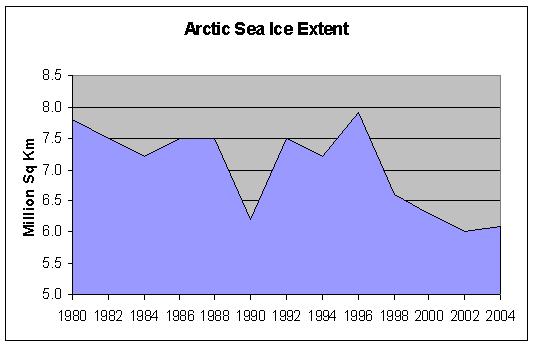
Do read the whole report, which underlines how little even scientists understand what drives the climate. Something I found odd is that the same page also has a graphic on Arctic sea ice extent, which is entitled: "Arctic Ice in Retreat." The data in the graphic plots as follows:

I do think the title is somewhat gratuitously misrepresenting the data... not to mention that the time frame is vanishingly small. Anyway, here (scroll down) is some more information about what is happening to glaciers in general.

Monday, June 19, 2006

'Mlle Thatcher' à l'Elysée?

Here is a story about someone I mentioned some time ago:
Sabine Hérold, who sprang to fame when she led a protest movement against French workers' readiness to go on strike, now hopes to exploit growing disillusionment with her country's political elite by winning a seat in parliament.
Miss Hérold, 25, who regards her French media nickname - Mlle Thatcher - as a compliment, also refuses to rule out standing as a candidate to replace Jacques Chirac as president next year.
Miss Hérold, a prominent figure in the new Liberal Alternative Party, told The Daily Telegraph last night that her aim was to restore French people's confidence in their country and society.
"I don't see myself as being of the Right," she insisted from Turkey, where she is on holiday. "Our concept of liberalism doesn't translate easily into English, but essentially means giving individuals the freedom and responsibility to make their own decisions in all areas of life." Miss Hérold found herself addressing crowds of up to 80,000 three years ago when she became the spearhead of a campaign against crippling anti-government strikes by public sector workers.
In her first attempt to win the hearts of French voters, she has chosen Paris's smart 16th arrondissement for her battleground. There, she will try to unseat Françoise de Panafieu, from the ruling centre-Right UMP party, who won a comfortable victory in the 2002 general election.
Quite a long shot, I would say, and that's all the more reason to admire her for fighting for these ideals. Maybe she'll do better than Abraham Lincoln... that's when the real fun would start.

Is reality malleable?

Here's a rather amusing look at how the same events can be presented in a different light. The BBC News website informs us:
Japan gains key whaling victory

Pro-whaling nations have won their first vote towards the resumption of commercial whaling for 20 years. The meeting of the International Whaling Commission backed the declaration by a majority of just one.
Anti-whaling countries say they will challenge the outcome, which Japan has described as "historic". But pro-whaling nations need support from three-quarters of the commission to overturn the 1986 ban aimed at protecting the endangered species.
The resolution, tabled by St Kitts and Nevis where the meeting is being held, declared: "The moratorium, which was clearly intended as a temporary measure, is no longer necessary."
The (London) Telegraph on the other hand reports:
Anti-whaling nations win 'great victory' against Japan proposals

Japan suffered an unexpected and total defeat when it tried to start attacking a 20-year-old ban on commercial whaling at the International Whaling Commission's meeting in the Caribbean state of St Kitts and Nevis last night.
The member countries of the UN whaling treaty voted down two proposals by Japan - the most significant one for secret ballots so that small Pacific and Caribbean nations that receive Japanese aid could unpick the protection of whales without fear of retribution. The other proposal sought to prevent the commission from discussing the fate of dolphins and porpoises as well as whales.
Meanwhile this seems to be the most factual account:
How the voting went at the IWC meeting

Japan won its first pro-whaling majority in more than two decades today at the International Whaling Commission when the group approved a declaration criticizing a 1986 ban on commercial whaling.
But Japan lost four more substantive votes at the IWC's June 16-20 meeting in St. Kitts and Nevis.
The first vote, proposed by Japan, was to prevent the IWC from discussing the fate of dolphins, porpoises and small whales in addition to great whales. Japan lost 30-32, with one abstention.
The second vote, also proposed by Japan, was to introduce secret balloting. It lost that vote 30-33, with one abstention.
The third vote, which would have allowed Japanese coastal communities to hunt a limited number of whales -- effectively circumventing the moratorium -- was lost by 30 votes to 31, with four abstentions.
Japan lost its fourth vote when it proposed eliminating a Southern Ocean whale sanctuary, for which it needed and did not expect a three-quarters majority. Japan had hoped to at least win a simple majority but lost 28-33, with four abstentions.
The fifth vote on the declaration, which called the moratorium unnecessary and which accused whales of eating "huge quantities of fish," was won by 33 votes to 32, with one abstention. Environmental activists blamed a "yes" vote by Denmark for passage of the statement.
They also have the voting list.
It's funny how even something apparently simple can seem so different depending on which account one reads. No doubt this is even more true of the really important and controversial stuff.

Post Scriptum:
À propos whaling, Daniel Drezner (via Instapundit) explains why the International Whaling Commission is his favourite international body, and notes the Independent's "rather hyperbolic" coverage of the story. No surprises from what has deliciously been called the "Daily Mail for people who recycle."

Monday, June 05, 2006

The situation in Iraq

Gateway Pundit (via MP) makes some interesting points on Iraq, and how things are going there:
The recorded Iraqi civilian fatalities (including insurgents, military, morgue counts, police, etc.) were down 16% (16% maximum) in 2005... 38% (48% maximum) less than 2003 (via Leftist anti-war site Iraq Body Count). If you take out the numbers from that horrible day in August 2005 when nearly one thousand panicked Iraqis were trampled or drowned near a Muslim shrine, the year shows striking progress compared to 2003 and 2004 with fatalities one third less than in 2004.
Do read the whole thing. Melanie Phillips notes:
Yes, abuses such as occurred at Abu Ghraib and now maybe Haditha have had a profound effect too. But once again, the way these have been reported -- as if the behaviour of the US military has been as bad as, if not even wose then, the terror perpetrated by Saddam -- has played a major role in breaking the public's spirit. Abuses happen in all military conflicts. Soldiers fighting for the most noble of ends sometimes behave in appalling ways. It's reprehensible, and should be punished. But dwelling upon it obsessively, inflating or distorting what happened and equating such aberrations with systematic tyranny, are all fuelling an atmosphere of hysteria in the west and handing Zarqawi his most potent weapon. If we had behaved like this during World War Two, we would have lost it.
Meanwhile Gene at Harry's Place expands a very interesting, and rarely mentioned, comparison with World War II:
He quotes from a book by Norman Lewis, who was stationed with the British army in Naples toward the end of World War II.
"What we saw was ineptitude and cowardice spreading down from the command, and this resulted in chaos...
"I saw an ugly sight: a British officer interrogating a civilian, and repeatedly hitting him about the head with the chair; treatment which the [civilian], his face a mask of blood, suffered with stoicism. At the end of the interrogation, which had not been considered successful, the officer called on a private and asked him in a pleasant, conversational sort of manner, 'Would you like to take this man away, and shoot him?' The private's reply was to spit on his hands, and say, 'I don't mind if I do, sir.'
"I received confirmation ... that American combat units were ordered by their officers to beat to death [those] who attempted to surrender to them. These men seem very naive and childlike, but some of them are beginning to question the ethics of this order.
"We liberated them from the Fascist Monster. And what is the prize? The rebirth of democracy. The glorious prospect of being able one day to choose their rulers from a list of powerful men, most of whose corruptions are generally known and accepted with weary resignation. The days of Mussolini must seem like a lost paradise compared to us."
Replace "Mussolini" with "Saddam" and you get one of the more mindless criticisms of the invasion of Iraq-- which doesn't stop Michael "Flying Kites" Moore and countless others from repeating it.
Add to Lewis's account the thousands of other atrocities surely committed by Allied forces during World War II, and the hundreds of thousands of German and Japanese civilians killed by the deliberate bombing of their neighborhoods, and the Iraq war seems almost pristine by comparison. And yet who will say that the world isn't a better place for the Allies having fought and defeated the Axis? Who will argue (as some have about Abu Ghraib and Haditha) that the Second World War atrocities were sufficient cause for stopping the fight and going home?
Abu Ghraib and Haditha have sickened me, and those responsible need to be held to account-- up to the highest ranks, including the secretary of defense. Having never experienced combat, I can't begin to imagine how stressful it is. But neither can I imagine any circumstances in which it is justified to shoot defenseless women and children.
And yet I also know that on the coalition side, atrocities are the exception and not a matter of strategy-- in contrast to the other side in the fight.
Do read the whole thing: I think he really strikes the correct balance in this piece.

Sunday, June 04, 2006

The Tiananmen Square Massacre

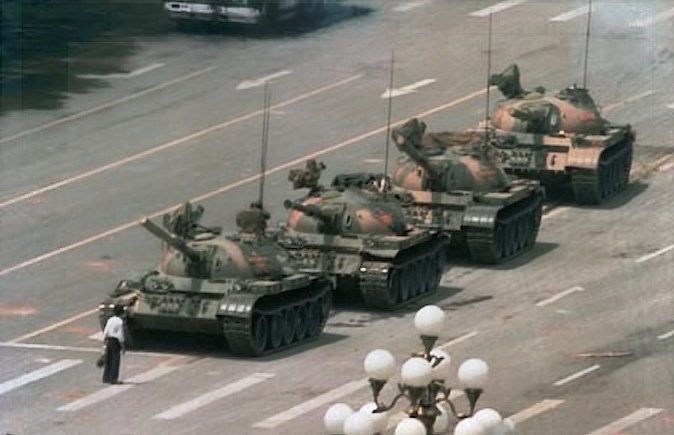
Today is the anniversary of the Tiananmen Square Massacre. Slate has an interesting photo essay and here is a gut-wrenching video which is well worth seeing (both via Instapundit).

(Photo: Jeff Widener - The Associated Press; source)
The victims' families and the world are still waiting for China to face up to its past.

Thursday, June 01, 2006

Lomborg is winning, thankfully

I became aware of the Johann Hari and Scott Burgess debate (which IMHO Scott is winning hands down) through the excellent EnviroSpin Watch. Some people where I work are fans of Harry's Place (which I enjoy as well), and came to the same debate through this post. After reading through it they came to the flabbergasting conclusion that Lomborg is misrepresenting himself. Huh?! It's funny how people who make the heritage of the Enlightenment their own, seem to have such trouble accepting hard facts, i.e. that Hari is clearly misrepresenting reality, Lomborg's positions and much else besides.
Anyway, as Philip points out, thankfully Lomborg etc. are clearly winning the practical debate:
Yet, despite the vitriol and abuse, in the solid world, beyond the febrile and hysterical rantings of a few (surprisingly few, I might add) European 'Greens', and some of the 'liberal' media, like The Independent, BBC television (far less BBC radio), and Channel 4, Lomborg is quietly winning the debate.
As Canada's The National Post (May 30) points out in 'Ottawa's Kyoto plan wins backers in Bonn', the Kyoto Protocol is slowly and inexorably being ditched and abandoned.
[...]
The economic imperative, coupled with dynamic adaptive innovation, will continue to thrive. Lomborg, in essence, has won. Hence the ill-tempered outbursts of Mr. Hari and his ilk. Sadly, in the meantime, such people have caused us to waste so much energy on sheer fantasies. As Lomborg says, we should be concentrating on getting the best outcomes for our money, especially for the poorest and the most disadvantaged in the world.
Do read the whole thing. Unfortunately Hari etc. seem intent on proving that they are totally unhinged from reality, which is a pity.

Friday, May 26, 2006

But he's still brilliant...

Since in my last post I criticised Christopher Hitchens, I would like to point out that I often find his writing to be brilliant. It gives voice, in concise and biting prose, to ideas and convictions which I have long held and could never express as effectively as he does. A few weeks ago he had an article in Slate on the war in Iraq, and there is not one syllable in it with which I disagree:
So, now I come at last to my ideal war. Let us start with President Bush's speech to the United Nations on Sept. 12, 2002, which I recommend that you read. Contrary to innumerable sneers, he did not speak only about WMD and terrorism, important though those considerations were. He presented an argument for regime change and democracy in Iraq and said, in effect, that the international community had tolerated Saddam's deadly system for far too long. Who could disagree with that? Here's what should have happened. The other member states of the United Nations should have said: Mr. President, in principle you are correct. The list of flouted U.N. resolutions is disgracefully long. Law has been broken, genocide has been committed, other member-states have been invaded, and our own weapons inspectors insulted and coerced and cheated. Let us all collectively decide how to move long-suffering Iraq into the post-Saddam era. We shall need to consider how much to set aside to rebuild the Iraqi economy, how to sponsor free elections, how to recuperate the devastated areas of the marshes and Kurdistan, how to try the war criminals, and how many multinational forces to ready for this task. In the meantime—this is of special importance—all governments will make it unmistakably plain to Saddam Hussein that he can count on nobody to save him. All Iraqi diplomats outside the country, and all officers and officials within it, will receive the single message that it is time for them to switch sides or face the consequences. Then, when we are ready, we shall issue a unanimous ultimatum backed by the threat of overwhelming force. We call on all democratic forces in all countries to prepare to lend a hand to the Iraqi people and assist them in recovering from more than three decades of fascism and war.
Not a huge amount to ask, when you think about it. But what did the president get instead? The threat of unilateral veto from Paris, Moscow, and Beijing. Private assurances to Saddam Hussein from members of the U.N. Security Council. Pharisaic fatuities from the United Nations' secretary-general, who had never had a single problem wheeling and dealing with Baghdad. The refusal to reappoint Rolf Ekeus—the only serious man in the U.N. inspectorate—to the job of invigilation. A tirade of opprobrium, accusing Bush of everything from an oil grab to a vendetta on behalf of his father to a secret subordination to a Jewish cabal. Platforms set up in major cities so that crowds could be harangued by hardened supporters of Milosevic and Saddam, some of them paid out of the oil-for-food bordello.
Do read the whole thing, which touches on the main issues working up to the war. I was recently trying to make a similar point to a friend of mine: Chirac should have gotten behind Bush's statements before the war, and there probably would have been no war because it would have been unnecessary. Unfortunately this friend of mine has IMHO a disingenuous faith (belied by history) in the workings of international law and therefore claimed that such a strategy would have been wrong because Chirac would have been creating damaging legal precedents by supporting a crime, and that Bush was obviously not interested in humanitarian intervention, otherwise the US would have filed the appropriate legal arguments. I clearly think that's a load of tosh, and this article goes a long way to explain why.

Hitchens conflates matters

Yesterday Christopher Hitchens gave a lecture, which I would have gone to had I not had tickets for Embers with Jeremy Irons (which was brilliant, by the way). Hitchens is a very interesting writer, of socialist extraction, with whom I often agree (notably on the war in Iraq), but who sometimes says some odd things, to put it mildly. Here is part of his speech, referring to the three monotheistic religions (emphasis mine):
The beginning of wisdom is to say that all these three sides need to be condemned to death and to hell. These people seriously want us all to die, if we won't adopt their faith. They look--they think of us, they think of you, all of us, as dispensable, as mere extras, as digits in their cosmic horror show. They look forward to the day when Armageddon comes. They look forward to the day when all the achievements of human civilization are cast into a pit and they have all that in common with one another and this is the perfect demonstration case and it's right before our eyes and you can read about it every day and that's how far we've got from the Age of Reason as well as The Rights of Man, because when reason dies, the rights of man are so obviously and so clearly and so utterly negated.
If this were true I would probably agree with his sentiments. Unfortunately it is emphatically untrue, at least in regard to Judaism, which is the only religion I can claim to have a throrough knowledge of. The idea that a religious Jew would want anyone to die if they did not accept Judaism is simply laughable. Even a superficial knowledge of Judaism, of its most ancient teachings and of how it has been practiced for millenia, would be sufficient for anyone to realize this. According to Jewish law, not only must a non-Jew who wants to convert to Judaism be discouraged from doing so on three separate occasions, but it is forbidden for Jews to even mildly and verbally encourage people to convert (let alone coerce someone by force). The reason for this is simple: Jews do not believe (and never have) that it is necessary to be Jewish to be a good person and go to heaven. If I understand correctly, this is not the case with some (or maybe most) believers of the other monotheistic religions, in which case Hitchens' comments would seem to be somewhat more justified. But I find it unfortunate (and frankly insulting) that in his quasi-religious atheistic zeal he should conflate the matters, and call for the death of all religious people.

Galloway shows his true colours

George Galloway (via Drudge) never fails to impress with the raving lunacy of his despicable world view:
The Respect MP George Galloway has said it would be morally justified for a suicide bomber to murder Tony Blair.
In an interview with GQ magazine, the reporter asked him: "Would the assassination of, say, Tony Blair by a suicide bomber - if there were no other casualties - be justified as revenge for the war on Iraq?"
Mr Galloway replied: "Yes, it would be morally justified. I am not calling for it - but if it happened it would be of a wholly different moral order to the events of 7/7. It would be entirely logical and explicable. And morally equivalent to ordering the deaths of thousands of innocent people in Iraq - as Blair did."
See Harry's Place for some interesting comments.

Quote of the day

Philip Stephens in today's Financial Times:
For all that the rhetoric is warmer and the US has rediscovered the mechanics of diplomacy, the sense of distance between the two sides is palpable. Even where they agree on the objective – as in the case of preventing Iran from acquiring a nuclear weapons capability – they see the world through different lenses. The impatience for pre-emptive action of the sole superpower still collides with the European predilection for thumb-sucking.
Europe just makes pride swell in my chest...

Wednesday, May 24, 2006

Lies about Iraq

Peter Wehner has an excellent editorial in the Wall Street Journal (via Instapundit) in which he ably debunks some of the antiwar myths (and even outright lies) which the MSM loves to perpetuate:
Iraqis can participate in three historic elections, pass the most liberal constitution in the Arab world, and form a unity government despite terrorist attacks and provocations. Yet for some critics of the president, these are minor matters. Like swallows to Capistrano, they keep returning to the same allegations--the president misled the country in order to justify the Iraq war; his administration pressured intelligence agencies to bias their judgments; Saddam Hussein turned out to be no threat since he didn't possess weapons of mass destruction; and helping democracy take root in the Middle East was a postwar rationalization. The problem with these charges is that they are false and can be shown to be so--and yet people continue to believe, and spread, them.
Do read the whole thing. A few months ago Commentary (pdf; see here for an html version) also published an indispensable and lucid editorial by Norman Podhoretz on the lengths which some people will go to, to dishonestly represent recent history. Independently of whether the war was right or wrong (and I'm absolutely convinced it was right, in case you hadn't noticed) more energy needs to be expended in eradicating these despicable attempts to rewrite history.

Erroneous report? Not so fast!

Yesterday, Financial Times columnist Victor Mallet made an interesting point about Western companies' cravenness when faced with Chinese censorship, and notes that it isn't limited to media and technology firms:
But what if Beijing’s interference were to extend to the suppression of the economic and financial information on which investors rely to make business decisions? Would executives in China feel as sanguine as they do today about curbs on free speech?
The publication and humiliating withdrawal of Ernst & Young's global report on non-performing loans this month serves as a warning that open discussion of the economy – especially politically sensitive matters such as the health of the big banks – is, in fact, already compromised.
[...]
In the China section of its report on May 3, E&Y estimated the total exposure of China's financial system to bad loans to be $911bn. That included $358bn – nearly three times the official figure – at the big four state banks. Nine days later, E&Y withdrew the whole report, saying the $358bn figure was "factually erroneous" and lamenting the absence of the "normal internal review and approval process" before publication.
E&Y's explanation is hard to swallow, if only because it suggests the organisation was unusually incompetent at its work as well as unusually lax with its controls. A more likely reason is that E&Y is trying to protect its China business and mollify the People's Bank of China, the central bank, which had publicly called the report "ridiculous and barely understandable" hours before E&Y backed down.
[...]
E&Y's report on China, however, was carefully worded. It noted the scarcity of accurate information in "a banking culture that resists openness" and referred to bad loans that could lurk in the category of "special mention" credits not included in official non-performing loan ratios.
It should not be forgotten that E&Y described its $911bn estimate as "conservative" or that its concerns (although not the exact numbers) are shared by PwC, McKinsey Global Institute and the International Monetary Fund.
At worst, E&Y put out a report that could be criticised and debated – not one that should have been dismissed out of hand.
That makes it all the sadder that E&Y backed down. Much more is at stake than the fate of the state banks, although it is easy to see signs of frenzied over-investment in property and infrastructure financed by the banks in China's big cities. The underlying problem is Beijing's determination to curb the free flow of awkward information. That will ultimately threaten China's economic modernisation as well as its political development.
Do read the whole thing. No doubt most people will remember E&Y's retraction and not the valid points it had made. Even so, sooner or later China's problems will come to light, and thankfully they do not bode well for the "It's the next superpower!" cheerleading squad.

Tuesday, May 23, 2006

What Prodi has (not) wrought

When the Economist theatrically accused former Italian PM Silvio Berlusconi of being unfit to lead a Western democracy (here and here; requires subs.), the main centrist Italian daily, Corriere della Sera, (and the press in general) made a big deal of it. During the recent election campaign, articles which appeared in the foreign press - critical of Berlusconi or his accomplishments - got widespread attention. Isn't it odd then, that when this week's Economist, rightfully, savages the composition of the new Prodi government, nobody seems to have noticed? Here are the juicy bits:
His government may be the most left-leaning that Italy has ever had. Of its 26 members, one belongs to the Green party, which in Italy stands well to the left; two are communists; and nine (including the foreign minister, Massimo D'Alema) are Democrats of the Left, heirs to the former Italian Communist Party. As expected, the finance ministry will go to a distinguished independent, Tommaso Padoa-Schioppa. But the other main economic portfolios—industry, employment and transport—are all going to communists or ex-communists. That scarcely augurs well for the radical (ie, liberal) reforms that Mr Prodi's centre-left alliance had promised.
[...]
One of these second-class ministers is a spirited former European commissioner, Emma Bonino, who will be Europe minister. She had wanted the defence ministry. Her failure to get it shows the problems created for Mr Prodi by his narrow victory—and suggests that his government may not last all that long.
[...]
To break the deadlock, Mr Prodi gave defence to a close associate, Arturo Parisi. But to pacify the troublesome Mr Mastella, he handed him the even more prestigious justice ministry. Mr Mastella expressed delighted surprise. As well he might: for he is utterly unsuitable. More than once, he has chided prosecutors for their impertinent curiosity about political corruption. Only three months ago he was questioned at the headquarters of the national anti-Mafia directorate about his friendship with a man who admitted to helping the Sicilian Cosa Nostra's former "boss of bosses", Bernardo Provenzano, when he was on the run.
Francesco Campanella, a town councillor in Sicily who turned state's evidence after being investigated, has acknowledged giving Mr Provenzano documents that helped him to go abroad for medical treatment. A year earlier, Mr Mastella was a witness at Mr Campanella's wedding.
The truth is that some of the members of Prodi's cabinet are well-respected, reform-minded policy experts. Nonetheless, it seems to me that they will not get very far. Given his paper-thin majority, Prodi should have offered the main center-right parties a grand coalition, instead of going with the awkward mixture of small and radical leftwing parties with which he is now stuck, dashing any hopes for meaningful reform. In doing so he could have posed the condition that Berlusconi step down from the Forza Italia party leadership (which Silvio had hinted he was willing to do, and his deputies are eagerly hoping for), finally ridding the political landscape of an inappropriate (albeit tragically amusing) figure. That Prodi did not do so means that Berlusconi is now as powerful as ever within his coalition (because his side did significantly better than expected), and already ahead of Prodi in the polls, while the current government is hostage to the whims of a group of oddballs, who are bent on undoing the few positive reforms which had been implemented in recent years. Excepting miracles, expect Prodi to accomplish little and Berlusconi to be back in the driver's seat sometime in the future. And we can thank Prodi's narrow-mindedness for that.

Thursday, May 18, 2006

Do you hear something?

Considering that from perusing the MSM one would get the impression that there is no rational and informed human being on earth who would deny that climate change is the major threat humanity is facing, a recent Melanie Phillips post on the issue of the melting scientific consensus is well worth reading. A group of eminent scientists have sent an open letter to the Canadian Prime Minister, asking that the debate over Kyoto be reopened. Melanie, who has long been skeptical, wonders:
Is that faint thundering I hear the sound of the cavalry arriving at last?
Well, if it is, it would certainly be music to my ears. The entire letter including its eye-popping list of signatories can be read here. Some of the highlights:
Observational evidence does not support today's computer climate models, so there is little reason to trust model predictions of the future. Yet this is precisely what the United Nations did in creating and promoting Kyoto and still does in the alarmist forecasts on which Canada's climate policies are based. Even if the climate models were realistic, the environmental impact of Canada delaying implementation of Kyoto or other greenhouse-gas reduction schemes, pending completion of consultations, would be insignificant.
[...]
While the confident pronouncements of scientifically unqualified environmental groups may provide for sensational headlines, they are no basis for mature policy formulation. The study of global climate change is, as you have said, an "emerging science," one that is perhaps the most complex ever tackled. It may be many years yet before we properly understand the Earth's climate system. Nevertheless, significant advances have been made since the protocol was created, many of which are taking us away from a concern about increasing greenhouse gases. If, back in the mid-1990s, we knew what we know today about climate, Kyoto would almost certainly not exist, because we would have concluded it was not necessary.
[...]
"Climate change is real" is a meaningless phrase used repeatedly by activists to convince the public that a climate catastrophe is looming and humanity is the cause. Neither of these fears is justified. Global climate changes all the time due to natural causes and the human impact still remains impossible to distinguish from this natural "noise." The new Canadian government's commitment to reducing air, land and water pollution is commendable, but allocating funds to "stopping climate change" would be irrational. We need to continue intensive research into the real causes of climate change and help our most vulnerable citizens adapt to whatever nature throws at us next.
And here, for the sake of its dramatic effect, is the list of signatories:
Dr. Ian D. Clark, professor, isotope hydrogeology and paleoclimatology, Dept. of Earth Sciences, University of Ottawa

Dr. Tad Murty, former senior research scientist, Dept. of Fisheries and Oceans, former director of Australia's National Tidal Facility and professor of earth sciences, Flinders University, Adelaide; currently adjunct professor, Departments of Civil Engineering and Earth Sciences, University of Ottawa

Dr. R. Timothy Patterson, professor, Dept. of Earth Sciences (paleoclimatology), Carleton University, Ottawa

Dr. Fred Michel, director, Institute of Environmental Science and associate professor, Dept. of Earth Sciences, Carleton University, Ottawa

Dr. Madhav Khandekar, former research scientist, Environment Canada. Member of editorial board of Climate Research and Natural Hazards

Dr. Paul Copper, FRSC, professor emeritus, Dept. of Earth Sciences, Laurentian University, Sudbury, Ont.

Dr. Ross McKitrick, associate professor, Dept. of Economics, University of Guelph, Ont.

Dr. Tim Ball, former professor of climatology, University of Winnipeg; environmental consultant

Dr. Andreas Prokoph, adjunct professor of earth sciences, University of Ottawa; consultant in statistics and geology

Mr. David Nowell, M.Sc. (Meteorology), fellow of the Royal Meteorological Society, Canadian member and past chairman of the NATO Meteorological Group, Ottawa

Dr. Christopher Essex, professor of applied mathematics and associate director of the Program in Theoretical Physics, University of Western Ontario, London, Ont.

Dr. Gordon E. Swaters, professor of applied mathematics, Dept. of Mathematical Sciences, and member, Geophysical Fluid Dynamics Research Group, University of Alberta

Dr. L. Graham Smith, associate professor, Dept. of Geography, University of Western Ontario, London, Ont.

Dr. G. Cornelis van Kooten, professor and Canada Research Chair in environmental studies and climate change, Dept. of Economics, University of Victoria

Dr. Petr Chylek, adjunct professor, Dept. of Physics and Atmospheric Science, Dalhousie University, Halifax

Dr./Cdr. M. R. Morgan, FRMS, climate consultant, former meteorology advisor to the World Meteorological Organization. Previously research scientist in climatology at University of Exeter, U.K.

Dr. Keith D. Hage, climate consultant and professor emeritus of Meteorology, University of Alberta

Dr. David E. Wojick, P.Eng., energy consultant, Star Tannery, Va., and Sioux Lookout, Ont.

Rob Scagel, M.Sc., forest microclimate specialist, principal consultant, Pacific Phytometric Consultants, Surrey, B.C.

Dr. Douglas Leahey, meteorologist and air-quality consultant, Calgary

Paavo Siitam, M.Sc., agronomist, chemist, Cobourg, Ont.

Dr. Chris de Freitas, climate scientist, associate professor, The University of Auckland, N.Z.

Dr. Richard S. Lindzen, Alfred P. Sloan professor of meteorology, Dept. of Earth, Atmospheric and Planetary Sciences, Massachusetts Institute of Technology

Dr. Freeman J. Dyson, emeritus professor of physics, Institute for Advanced Studies, Princeton, N.J.

Mr. George Taylor, Dept. of Meteorology, Oregon State University; Oregon State climatologist; past president, American Association of State Climatologists

Dr. Ian Plimer, professor of geology, School of Earth and Environmental Sciences, University of Adelaide; emeritus professor of earth sciences, University of Melbourne, Australia

Dr. R.M. Carter, professor, Marine Geophysical Laboratory, James Cook University, Townsville, Australia

Mr. William Kininmonth, Australasian Climate Research, former Head National Climate Centre, Australian Bureau of Meteorology; former Australian delegate to World Meteorological Organization Commission for Climatology, Scientific and Technical Review

Dr. Hendrik Tennekes, former director of research, Royal Netherlands Meteorological Institute

Dr. Gerrit J. van der Lingen, geologist/paleoclimatologist, Climate Change Consultant, Geoscience Research and Investigations, New Zealand

Dr. Patrick J. Michaels, professor of environmental sciences, University of Virginia

Dr. Nils-Axel Morner, emeritus professor of paleogeophysics & geodynamics, Stockholm University, Stockholm, Sweden

Dr. Gary D. Sharp, Center for Climate/Ocean Resources Study, Salinas, Calif.

Dr. Roy W. Spencer, principal research scientist, Earth System Science Center, The University of Alabama, Huntsville

Dr. Al Pekarek, associate professor of geology, Earth and Atmospheric Sciences Dept., St. Cloud State University, St. Cloud, Minn.

Dr. Marcel Leroux, professor emeritus of climatology, University of Lyon, France; former director of Laboratory of Climatology, Risks and Environment, CNRS

Dr. Paul Reiter, professor, Institut Pasteur, Unit of Insects and Infectious Diseases, Paris, France. Expert reviewer, IPCC Working group II, chapter 8 (human health)

Dr. Zbigniew Jaworowski, physicist and chairman, Scientific Council of Central Laboratory for Radiological Protection, Warsaw, Poland

Dr. Sonja Boehmer-Christiansen, reader, Dept. of Geography, University of Hull, U.K.; editor, Energy & Environment

Dr. Hans H.J. Labohm, former advisor to the executive board, Clingendael Institute (The Netherlands Institute of International Relations) and an economist who has focused on climate change

Dr. Lee C. Gerhard, senior scientist emeritus, University of Kansas, past director and state geologist, Kansas Geological Survey

Dr. Asmunn Moene, past head of the Forecasting Centre, Meteorological Institute, Norway

Dr. August H. Auer, past professor of atmospheric science, University of Wyoming; previously chief meteorologist, Meteorological Service (MetService) of New Zealand

Dr. Vincent Gray, expert reviewer for the IPCC and author of The Greenhouse Delusion: A Critique of 'Climate Change 2001,' Wellington, N.Z.

Dr. Howard Hayden, emeritus professor of physics, University of Connecticut

Dr Benny Peiser, professor of social anthropology, Faculty of Science, Liverpool John Moores University, U.K.

Dr. Jack Barrett, chemist and spectroscopist, formerly with Imperial College London, U.K.

Dr. William J.R. Alexander, professor emeritus, Dept. of Civil and Biosystems Engineering, University of Pretoria, South Africa. Member, United Nations Scientific and Technical Committee on Natural Disasters, 1994-2000

Dr. S. Fred Singer, professor emeritus of environmental sciences, University of Virginia; former director, U.S. Weather Satellite Service

Dr. Harry N.A. Priem, emeritus professor of planetary geology and isotope geophysics, Utrecht University; former director of the Netherlands Institute for Isotope Geosciences; past president of the Royal Netherlands Geological & Mining Society

Dr. Robert H. Essenhigh, E.G. Bailey professor of energy conversion, Dept. of Mechanical Engineering, The Ohio State University

Dr. Sallie Baliunas, astrophysicist and climate researcher, Boston, Mass.

Douglas Hoyt, senior scientist at Raytheon (retired) and co-author of the book The Role of the Sun in Climate Change; previously with NCAR, NOAA, and the World Radiation Center, Davos, Switzerland

Dipl.-Ing. Peter Dietze, independent energy advisor and scientific climate and carbon modeller, official IPCC reviewer, Bavaria, Germany

Dr. Boris Winterhalter, senior marine researcher (retired), Geological Survey of Finland, former professor in marine geology, University of Helsinki, Finland

Dr. Wibjorn Karlen, emeritus professor, Dept. of Physical Geography and Quaternary Geology, Stockholm University, Sweden

Dr. Hugh W. Ellsaesser, physicist/meteorologist, previously with the Lawrence Livermore National Laboratory, Calif.; atmospheric consultant.

Dr. Art Robinson, founder, Oregon Institute of Science and Medicine, Cave Junction, Ore.

Dr. Arthur Rorsch, emeritus professor of molecular genetics, Leiden University, The Netherlands; past board member, Netherlands organization for applied research (TNO) in environmental, food and public health

Dr. Alister McFarquhar, Downing College, Cambridge, U.K.; international economist

Dr. Richard S. Courtney, climate and atmospheric science consultant, IPCC expert reviewer, U.K.
I do believe I hear the thundering as well.

Monday, May 15, 2006

Freedom and punishment

In many respects I consider myself a libertarian, and I agree with much of the outrage expressed in some quarters (Samizdata, for one) over the UK government's curtailing of civil liberties. On the other hand there are trends and behaviours which I think it is the responsibility of the State to curtail, decisively if need be, and I don't feel that these two concepts are at all contradictory. This dichotomy is inherent in some rather interesting recent comments by Theodore Dalrymple in City Journal:
Returning briefly to England from France for a speaking engagement, I bought three of the major dailies to catch up on the latest developments in my native land. The impression they gave was of a country in the grip of a thoroughgoing moral frivolity. In a strange inversion of proper priorities, important matters are taken lightly and trivial ones taken seriously.
This is not the charming or uplifting frivolity of Feydeau's farces or Oscar Wilde's comedies; it is the frivolity of real decadence, bespeaking a profound failure of nerve bound to have disastrous consequences for the country's quality of life. The newspapers portrayed frivolity without gaiety and earnestness without seriousness—a most unattractive combination.
Do read the whole thing. In this respect today’s remarks by Tony Blair seem to be somewhat encouraging:
Launching Labour's Let's Talk consultation, Mr Blair said: "I believe people want a society without prejudice but with rules - rules that are fair, that we all play by, and rules that when broken carry a penalty.
"And the truth is that most people don't think we have sufficiently such a society."
Mr Blair said there should not be "continual legal battles to deport people who are committing serious crimes or inciting extremism".
Drug-abusing offenders should not be put back out on the street without proper supervision, he said, and people flouting probation orders had to be penalised.
The lack of a connection between what the public expects from the criminal justice system and what it gets is becoming a recurrent theme for Mr Blair.
Maybe he too reads Dalrymple? It seems to me that if what he is saying is in fact a realistic assessment of the prevailing public opinion, then there is still hope for reform, be it under his watch or under his successor's.
At any rate, it seems clear to me that an appropriate balance can be stricken, and that there is much work to be done to reach that point. On the one hand it is appalling that people are being arrested for making frivolous comments. Everyone should be able to say absolutely anything they want, no matter how controversial, counterfactual or offensive it may be, as long as they are not directly inciting to acts of violence. This is clealy not the case at the moment, which I find deplorable. At the same time a person who visits violence on others (unless it is clearly in self-defence) needs to be subjected to extremely severe punishment, which should allow (limited) flexibility only in extraordinary cases of intense remorse and a proven willingness and ability to make a new start. This is also not the case at the moment, and Tony Blair, rightfully in this respect, indirectly blames the "human rights" and "civil liberties" crowd for this, as they focus exclusively on the rights and liberties of those who should be punished and not on those of everyone else.