Showing posts with label Climate change. Show all posts

Sunday, July 01, 2007

Cooler heads?

It would seem that cooler heads may be prevailing in the global warming debate. Even in the UK where the global warming orthodoxy is actively supported by many media outlets - for example, I bet you weren't aware that US carbon emissions fell in 2006 - according to a recent survey by Pocket Issue more than two-thirds of the respondents believe that climate change is a natural phenomenon which has little to do with human actions:
Almost three quarters of people believe global warming is a 'natural occurrence' and not a result of carbon emissions, a survey claimed today. This goes against the views of the vast majority of scientists who believe the rise in the earth's temperatures is due to pollution. The online study which polled nearly 4000 votes found that a staggering 71 percent of people think that the rise in air temperature happens naturally. And 65 percent think that scientists' catastrophic predictions if pollution isn't curbed are 'far fetched'.
Admittedly this is an online survey, whose accuracy is unclear to me, but the results still seem encouraging.
Meanwhile, isn't it ironic that Al Gore constantly invokes science and reason, while peddling the most exaggerated (and unscientific) claims to encourage people to join his global warming cult? If you think I'm just being snarky about him because I disagree with his politics and policies, I think a recent essay in the Chicago Sun Times would be well worth reading. In it James Taylor points out how many of the Goracle's most famous claims have little relation to scientific research published in mainstream scientific journals. Here are the juicy bits:
For example, Gore claims that Himalayan glaciers are shrinking and global warming is to blame. Yet the September 2006 issue of the American Meteorological Society's Journal of Climate reported, "Glaciers are growing in the Himalayan Mountains, confounding global warming alarmists who recently claimed the glaciers were shrinking and that global warming was to blame."
Gore claims the snowcap atop Africa's Mt. Kilimanjaro is shrinking and that global warming is to blame. Yet according to the November 23, 2003, issue of Nature magazine, "Although it's tempting to blame the ice loss on global warming, researchers think that deforestation of the mountain's foothills is the more likely culprit. Without the forests' humidity, previously moisture-laden winds blew dry. No longer replenished with water, the ice is evaporating in the strong equatorial sunshine."
Gore claims global warming is causing more tornadoes. Yet the United Nations Intergovernmental Panel on Climate Change stated in February that there has been no scientific link established between global warming and tornadoes.
Gore claims global warming is causing more frequent and severe hurricanes. However, hurricane expert Chris Landsea published a study on May 1 documenting that hurricane activity is no higher now than in decades past. Hurricane expert William Gray reported just a few days earlier, on April 27, that the number of major hurricanes making landfall on the U.S. Atlantic coast has declined in the past 40 years. Hurricane scientists reported in the April 18 Geophysical Research Letters that global warming enhances wind shear, which will prevent a significant increase in future hurricane activity.
Gore claims global warming is causing an expansion of African deserts. However, the Sept. 16, 2002, issue of New Scientist reports, "Africa's deserts are in 'spectacular' retreat . . . making farming viable again in what were some of the most arid parts of Africa."
Gore argues Greenland is in rapid meltdown, and that this threatens to raise sea levels by 20 feet. But according to a 2005 study in the Journal of Glaciology, "the Greenland ice sheet is thinning at the margins and growing inland, with a small overall mass gain." In late 2006, researchers at the Danish Meteorological Institute reported that the past two decades were the coldest for Greenland since the 1910s.
Gore claims the Antarctic ice sheet is melting because of global warming. Yet the Jan. 14, 2002, issue of Nature magazine reported Antarctica as a whole has been dramatically cooling for decades. More recently, scientists reported in the September 2006 issue of the British journal Philosophical Transactions of the Royal Society Series A: Mathematical, Physical, and Engineering Sciences, that satellite measurements of the Antarctic ice sheet showed significant growth between 1992 and 2003. And the U.N. Climate Change panel reported in February 2007 that Antarctica is unlikely to lose any ice mass during the remainder of the century.
Do read the whole thing.

Post Scriptum:
As I expected, the online poll I mention above, seems to be far from accurate, but underlines a real trend: a majority of people in the UK, according to a more traditional poll, seem to be skeptical of the global warming orthodoxy. BBC News reports:
The public believes the effects of global warming on the climate are not as bad as politicians and scientists claim, a poll has suggested. The Ipsos Mori poll of 2,032 adults - interviewed between 14 and 20 June - found 56% believed scientists were still questioning climate change. There was a feeling the problem was exaggerated to make money, it found.
The Royal Society said most climate scientists believed humans were having an "unprecedented" effect on climate. The survey suggested that terrorism, graffiti, crime and dog mess were all of more concern than climate change.
I must say I'm very pleased about this.
Meanwhile Tim Blair has a hilarious takedown of the Live Earth concerts:
Consider the vast carbon footprint of Live Earth, during which the world's most indulgent people - rock stars - will demand that their followers pledge to "take personal action to help solve the climate crises by reducing my own C02 pollution as much as I can."
Has Live Earth performer Keith Urban sold his Bentleys yet? (Actually, merely selling those 12-cylinder babies won’t reduce C02 emissions; he must destroy them.) I’ve been trying to come up with a violently destructive Gaia-raping stunt for us to participate in on Live Earth day, but it is literally impossible for even several thousand non-millionaires to match Live Earth's own level of eco-vandalism while remaining within their means and the law.
We've been out-carboned by Big Environmentalism. There’s simply no way we can come close to matching the colossal carbon output of Gore and his musical mates.
Do read the whole thing.

Tuesday, January 30, 2007

Indifference and common sense

As I read this New York Times article, I was reminded – as occasionally happens – of why, at the end of the day, I am proud to be Italian (emphasis mine):
To chief executives, the threat of global warming seems very real in Asia, but not in the United States or Russia.
A survey of chief executives around the world, released at the World Economic Forum in Davos, Switzerland, this week, found widespread optimism about profits and nearly universal complaints about excessive regulation of business.
Over all, 40 percent of the chief executives surveyed said they were either somewhat concerned or extremely concerned about global warming. But in the United States, the figure was less than half as high, only 18 percent. By contrast, the figure was 49 percent for chief executives in China, 60 percent for South Korean chiefs and 70 percent for Japanese bosses.
[...]
Within Western Europe, the figures were all over the place. Italian bosses voiced less concern than Americans, but more than half of the German chief executives said they were worried.
Ironically, if the conventional narrative is to be believed, it is Germany which is set to gain from "climate change" and Italy which is set to lose out. No doubt this discrepancy has something to do with German eccentricity.
Meanwhile, there has been an amusing, Drudge-fuelled spat recently, which brought out some sensible arguments. It all started with an idiotic blog post by Weather Channel climate expert Heidi Cullen, who wrote:
If a meteorologist can't speak to the fundamental science of climate change, then maybe the AMS shouldn't give them a Seal of Approval. Clearly, the AMS doesn't agree that global warming can be blamed on cyclical weather patterns. It's like allowing a meteorologist to go on-air and say that hurricanes rotate clockwise and tsunamis are caused by the weather. It's not a political statement... it's just an incorrect statement.
James Spann, a metereologist for ABC 33/40, wrote a sensibly hard-hitting response:
Well, well. Some "climate expert" on "The Weather Channel" wants to take away AMS certification from those of us who believe the recent "global warming" is a natural process. So much for "tolerance", huh?
I have been in operational meteorology since 1978, and I know dozens and dozens of broadcast meteorologists all over the country. Our big job: look at a large volume of raw data and come up with a public weather forecast for the next seven days. I do not know of a single TV meteorologist who buys into the man-made global warming hype. I know there must be a few out there, but I can't find them. Here are the basic facts you need to know:
  • Billions of dollars of grant money is flowing into the pockets of those on the man-made global warming bandwagon. No man-made global warming, the money dries up. This is big money, make no mistake about it. Always follow the money trail and it tells a story. Even the lady at "The Weather Channel" probably gets paid good money for a prime time show on climate change. No man-made global warming, no show, and no salary. Nothing wrong with making money at all, but when money becomes the motivation for a scientific conclusion, then we have a problem. For many, global warming is a big cash grab.
  • The climate of this planet has been changing since God put the planet here. It will always change, and the warming in the last 10 years is not much difference than the warming we saw in the 1930s and other decades. And, lets not forget we are at the end of the ice age in which ice covered most of North America and Northern Europe.
If you don’t like to listen to me, find another meteorologist with no tie to grant money for research on the subject. I would not listen to anyone that is a politician, a journalist, or someone in science who is generating revenue from this issue.
In fact, I encourage you to listen to WeatherBrains episode number 12, featuring Alabama State Climatologist John Christy, and WeatherBrains episode number 17, featuring Dr. William Gray of Colorado State University, one of the most brilliant minds in our science.
WeatherBrains, by the way, is our weekly 30 minute netcast.
I have nothing against "The Weather Channel", but they have crossed the line into a political and cultural region where I simply won’t go.
You tell 'em, James! Obviously, as this was linked by Matt Drudge, it got enourmous amounts of attention (it even bogged down the servers of the US Senate website!). See here and here for some further links and information.
People who really do care about the environment - as opposed to political grandstanding - should follow the recommendations of a new report by the Globalisation Institute, entitled Positive Environmentalism: A Convenient Truth (pdf). The Institute's blog summarises:
The debate about climate change solutions has been hijacked by "negative environmentalism", the view that thinks that improving the environment has to be done through big government plans to restrict foreign holidays, limit trade, force local shopping, or curb GDP. It regards the rise of India and China with dread. Economic growth is seen as finite: the West, in this view, has become rich at the expense of the planet, and there are not enough resources to sustain increasing economic prosperity in the emerging economies.
Instead, the report says, policymakers need to adopt "positive environmentalism". This view recognises the importance of dealing with environmental problems but rejects the doom and gloom approach so commonly encountered. It sees the great environmental achievements over the past century and rejects the notion that there are long term limits to economic prosperity. It sees the importance of technology, innovation and economic growth in tackling climate change.
According to the report, there is a convenient truth about growth and the environment: "becoming wealthier and more prosperous in the coming century is not the enemy of environmental progress: it is its very heart and soul."
It says that: "Instead of a fear of economic growth, policymakers should see it as a force for good. Within decades, technological progress, funded by growth, will break the relationship between GDP and carbon emissions. An approach to climate change that emphasises technological progress hand in hand with growth offers the best way to tackle the issue of the developing economies. Our approach to India and China must be more savvy than trying to beat them into an international agreement that is not in their interests."
Do read the whole thing.

Tuesday, January 16, 2007

Striking blows for reason

Before the holidays, Christopher Monckton, a former policy adviser to Margaret Thatcher, was much in evidence in the debate over global warming. As far as I can tell, it all started with two essays by him in the Sunday Telegraph, which I first saw mentioned at Andrew Bolt Blog (here and here). The first essay, entitled Climate Chaos? Don't believe it appeared on November 5th, 2006. The relative references and technical notes can be found here (pdf), and some of the correspondence generated by the article can be found here (pdf). The second article, entitled Wrong problem, wrong solution was published on November 15th, 2006. Polemicist George Monbiot responded to the articles in the Guardian, to which Monckton responded here, and Al Gore responded in the Sunday Telegraph, to which Monckton responded with a thorough debunking here (pdf). And finally, Monckton also responds here (pdf) to the Rockefeller-Snowe letter sent to ExxonMobil CEO Rex Tillerson, and his letter's summary was picked up by the Drudge Report (which reportedly has an average of 10,000,000 visits a day).
Meanwhile, Andrew Bolt also points out an excellent speech on the subject by another peer, Nigel Lawson. The speech was delivered at the Centre For Policy Studies, and makes what he calls "an appeal to reason." The speech can be heard here, and the transcript can be found here. Highly recommended.

Sunday, January 07, 2007

Bluffing one's way to influence

As in years past, I spent the holidays skiing in Lech am Arlberg, in the Austrian Alps. There was a bit less snow than usual, but plenty for skiing, and I had a lot of fun. I hope everyone else had a nice time during their holidays.
While I was there, I didn't have regular access to the internet, but I bought the Wall Street Journal Europe, which ran an interesting editorial (subs. required; free version here) about Russia's gas reserves:
At first sight the prospect of a significant supply shortage appears improbable. After all, Russia has 47 trillion cubic meters of proven gas reserves. On closer examination, including research by former Russian Deputy Energy Minister Vladimir Milov and the International Energy Agency (IEA), it is clear that Russian gas production is marked by two salient features. First, reliance on three old, declining, Soviet-era supergiant gas fields in the Nadym Pur Taz (NPT) region and the Zapolyarnoye field, a Soviet legacy project. Second, the lack of investment in opening up new major gas fields.
When challenged on this issue, Gazprom responds that it spends $11 billion annually on infrastructure, just as the IEA recommends. The trouble is that it's making the wrong sort of investments. Gazprom is not investing in new gas wells, pipelines and compressor stations, but in export infrastructure such as the North European Pipeline to Germany and the acquisition of foreign downstream energy assets. Taken together, the declining old fields and the lack of investment in new ones create a potentially major supply problem.
Mr. Milov, who now heads the Institute for Energy Policy in Moscow, estimates that by 2010 the deficit between Gazprom's supply and expected demand could be 126 billion cubic meters (bcm). To give that figure some context, the European Union imported approximately 155 bcm from Russia in 2005. Worse still, there are strong grounds for believing that the 126 bcm gap could grow. Mr. Milov assumes that the Central Asian states will be able to deliver 105 bcm annually. Unfortunately, there are doubts as to whether the Central Asian fields, which have seen even less investment than the Russian fields, can produce that amount of gas. And even if they could produce 105 bcm, according to the IEA they could only transport 50 bcm to Russia thanks to decayed pipelines. There are also concerns over the rate at which homes and factories in Russia are being hooked up to the main gas network, further increasing demand, and concerns that as the NPT fields begin to dry up their depletion rate, just as with the U.K. continental shelf fields, will accelerate.
Given the number of variables it is difficult to put a definitive number on the size of the deficit. But it looks as if the gap could be somewhere between 125 bcm and 200 bcm. Even at the lower end, such a deficit would severely strain EU gas supplies. Ironically Russia's greatest Western ally, Germany, stands to suffer most since it is at the end of the Russian supply system and it takes more Russian gas than any other country in Western Europe. The North European Pipeline will not be finished by 2010 -- and even if it were, there is the question of whether there would be enough gas for it.
Do read the whole thing, in which the author also proposes a way in which Europe can minimise the problem.
In a similar vein, there seems to be a growing number of voices arguing that the West should not adapt its foreign policy based on the fear that unsavoury regimes will use their energy supplies to blackmail us, particularly in the case of Iran. In a recent peer-reviewed paper entitled "The Iranian petroleum crisis and United States national security" which is to appear in Proceedings of the National Academy of Sciences, Roger J. Stern, a researcher at Johns Hopkins University sets out a convincing argument that the so-called "oil-weapon" is in reality toothless (see the press release). The Telegraph summarises (via Instapundit; emphasis mine):
Iran's oil exports are plummeting at 10pc a year on lack of investment and could be exhausted within a decade, depriving the world economy of its second-biggest source of crude supplies. A report by the US National Academy of Sciences said rickety infrastructure dating back to the era of the Shah had crippled output, while local fuel use was rising at 6pc a year.
"Their domestic demand is growing at the highest rate of any country in the world," said Prof Roger Stern, an Iran expert at Johns Hopkins University, Baltimore. "They need to invest $2.5bn (£1.28bn) a year just to stand still and they're not doing it because it's politically easier to spend the money on social welfare and the army than to wait four to six years for a return on investment," he said. "They've been running down the industry like this for 20 years."
Prof Stern said Teheran faces impending disaster since it relies on oil revenues for 70pc of its budget. "They cannot afford to carry out their threats to shut off oil supplies," he said. "There is no oil weapon, it's just a bluff."
Meanwhile, M. Simon of Power and Control, who is guest blogging at Classical Values notes (via Instapundit), that the situation is so bad that Iran seems to be having difficulties maintaining supply (in this case of natural gas) even now, as UPI reports:
Iran has stopped exports of natural gas to Turkey due to a tight domestic market caused by cold weather, but vows to restart shipments soon. Iran supplies Turkey from the Tabriz to Ankara pipeline as part of a 1996 contract. This year Turkey was to receive a total of 10 billion cubic meters of Iranian gas, the state-run IRNA news agency reports. "Currently our export to Turkey is zero," Oil Minister Kazem Vaziri-Hamaneh said. He said he called the Turkish energy minister and apologized "and promised to address these problems as soon as possible."
Also see this interesting Power and Control post, about Iran's current internal problems more in general. All this underlines the fact that, as I noted here and here, the West should stop telling itself that nothing can be done to resolve crises in these countries because they will ruin our economies by stopping fuel exports.
This is even more true in light of an interesting prediction made a few days ago by R. James Woolsey in the Wall Street Journal (free link; via Instapundit). After discussing various alternative fuels, he says:
All this is likely to change decisively, because electricity is about to become a major partner with alternative liquid fuels in replacing oil.
The change is being driven by innovations in the batteries that now power modern electronics. If hybrid gasoline-electric cars are provided with advanced batteries (GM's announcement said its choice would be lithium-ion) having improved energy and power density--variants of the ones in our computers and cell phones--dozens of vehicle prototypes are now demonstrating that these "plug-in hybrids" can more than double hybrids' overall (gasoline) mileage. With a plug-in, charging your car overnight from an ordinary 110-volt socket in your garage lets you drive 20 miles or more on the electricity stored in the topped-up battery before the car lapses into its normal hybrid mode. If you forget to charge or exceed 20 miles, no problem, you then just have a regular hybrid with the insurance of liquid fuel in the tank. And during those 20 all-electric miles you will be driving at a cost of between a penny and three cents a mile instead of the current 10-cent-a-mile cost of gasoline.
Utilities are rapidly becoming quite interested in plug-ins because of the substantial benefit to them of being able to sell off-peak power at night. Because off-peak nighttime charging uses unutilized capacity, DOE's Pacific Northwest National Laboratory estimates that adopting plug-ins will not create a need for new base load electricity generation plants until plug-ins constitute over 84% of the country's 220 million passenger vehicles.
[...]
Environmentalists should join this march with enthusiasm. Replacing hydrocarbons with fuels derived from biomass and waste reduces vehicles' carbon emissions very substantially. And replacing gasoline with electricity further brightens the environmental picture. The Environmental and Energy Study Institute has shown that, with today's electricity grid, there would be a national average reduction in carbon emissions by about 60% per vehicle when a plug-in hybrid with 20-mile all-electric range replaces a conventional car.
Subsidizing expensive substitutes for petroleum, ignoring the massive infrastructure costs needed to fuel family cars with hydrogen, searching for a single elegant solution--none of this has worked, nor will it. Instead we should encourage a portfolio of inexpensive fuels, including electricity, that requires very little infrastructure change and let its components work together: A 50 mpg hybrid, once it becomes a plug-in, will likely get solidly over 100 mpg of gasoline (call it "mpgg"); if it is also a flexible fuel vehicle using 85% ethanol, E-85, its mpgg rises to around 500.
Do read the whole thing.

Thursday, November 16, 2006

Have we thought of the victims?

Even assuming that climate change is a serious problem I find it amazing how many companies and people go around glibly boasting that they have "offset" all or part of their carbon emissions. Austin Williams in Sp!ked explains the incredible hypocrisy and quasi-imperalistic thoghtlessness of this approach, which basically involves the idea that since our Western technologies currently emit carbon dioxide we will pay some of the money we earn as a result of our level of development to encourage developing countries to implement low-technology, carbon neutral projects that ensure their economies do not industrialize like ours (which IMHO is the equivalent of saying: we got there first and we intend to keep all the goodies). This idea is despicable, not to mention idiotic, since it is the further development of technology that offers the only viable solutions. On a similar tack, Paul Driessen (the author of the excellent Eco-Imperialism) has an interesting article in Townhall (via GayandRight) which explains who the real victims in this travesty are:
Just the current Kyoto Protocol could cost the world up to $1 trillion per year, in regulatory bills, higher energy costs and lost productivity. That’s several times more than the price tag for providing the world with clean drinking water and sanitation – which would prevent millions of deaths annually from intestinal diseases.
Over 2 billion of the Earth's citizens still do not have electricity, to provide basic necessities like lights, refrigeration and modern hospitals. Instead they breathe polluted smoke from wood and dung fires, and die by the millions from lung diseases. But opposition to fossil fuel power plants, in the name of preventing climate change, ensures that these "indigenous" lifestyles, diseases and deaths will continue.
Opposition to hydroelectric projects (damming rivers) and nuclear power (radioactive wastes) likewise perpetuates endemic Third World poverty. So would a new European Union proposal to tax imports from China, India and other poor countries that are exempt from the Kyoto Protocol, because this gives them an "unfair trade advantage" over EU countries that are struggling to meet their Kyoto #1 commitments.
[...]
Yet, even perfect compliance with Kyoto would result in Earth's temperature being only 0.2 degrees F less by 2050 than under a business-as-usual scenario.
Do read the whole thing, which also puts the kibosh on some of the more outrageous claims floating around.
Another trend that I find simply flabbergasting is the idea, put forward by some, that the "debate is closed" on this subject. Apart from the significant number of prominent scientists who disagree with the supposed "consensus" view, how can the scientific debate be closed on a subject, if one of the fundamental tenets of the scientific method is falsifiability? Roy Spencer has an interesting article on this point in TCS Daily, and Brendan O'Neill makes a particularly spirited case in Sp!ked arguing that the demonisation of "climate change denial" is an affront to open and rational debate. Do read the whole thing.

Tuesday, November 14, 2006

The Stern Review

A few weeks ago the British government put out a report about climate change, entitled "The Stern Review" which made quite a splash. BBC News reported:
Global warming could cut the world's annual economic output by as much as 20%, an influential report by Sir Nicholas Stern is expected to say.
While that is a worst case scenario, the report claims that at the very best the cost of tackling global warming would be 1% of annual economic output.
Sir Nicholas's comments are expected to form the core of The Stern Review that is due to be released on Monday.
A summary and the whole document can be found here. In an essay for the Wall Street Journal (via The Volokh Conspiracy), Bjørn Lomborg explains why this report is deeply flawed:
The review correctly points out that climate change is a real problem, and that it is caused by human greenhouse-gas emissions. Little else is right, however, and the report seems hastily put-together, with many sloppy errors. As an example, the cost of hurricanes in the U.S. is said to be both 0.13% of U.S. GDP and 10 times that figure.
The review is also one-sided, focusing almost exclusively on carbon-emission cuts as the solution to the problem of climate change. Mr. Stern sees increasing hurricane damage in the U.S. as a powerful argument for carbon controls. However, hurricane damage is increasing predominantly because there are more people with more goods to be damaged, settling in ever more risky habitats. Even if global warming does significantly increase the power of hurricanes, it is estimated that 95% to 98% of the increased damage will be due to demographics. The review acknowledges that simple initiatives like bracing and securing roof trusses and walls can cheaply reduce damage by more than 80%; yet its policy recommendations on expensive carbon reductions promise to cut the damages by 1% to 2% at best. That is a bad deal.
Mr. Stern is also selective, often seeming to cherry-pick statistics to fit an argument. This is demonstrated most clearly in the review's examination of the social damage costs of CO2--essentially the environmental cost of emitting each extra ton of CO2. The most well-recognized climate economist in the world is probably Yale University's William Nordhaus, whose "approach is perhaps closest in spirit to ours," according to the Stern review. Mr. Nordhaus finds that the social cost of CO2 is $2.50 per ton. Mr. Stern, however, uses a figure of $85 per ton. Picking a rate even higher than the official U.K. estimates--that have themselves been criticized for being over the top--speaks volumes.
[...]
But nowhere is the imbalance clearer than in Mr. Stern's central argument about the costs and benefits of action on climate change. The review tells us that we should make significant cuts in carbon emissions to stabilize the concentration of atmospheric carbon dioxide at 550 ppm (parts per million). Yet such a stark recommendation is not matched by an explicit explanation of what this would mean in terms of temperature.
The U.N. Climate Panel estimates that stabilizing at 550 ppm would mean an increase in temperature of about 2.3 degrees Celsius in the year 2100. This might be several degrees below what would otherwise happen, but it might also be higher. Mr. Nordhaus estimates that the stabilization policy would reduce the rise in temperature from 2.53 degrees Celsius to just 2.42 degrees Celsius. One can understand the reluctance of the Stern review to advertise such a puny effect.
[...]
The Stern review's cornerstone argument for immediate and strong action now is based on the suggestion that doing nothing about climate change costs 20% of GDP now, and doing something only costs 1%. However, this argument hinges on three very problematic assumptions.
First, it assumes that if we act, we will not still have to pay. But this is not so--Mr. Stern actually tells us that his solution is "already associated with significant risks." Second, it requires the cost of action to be as cheap as he tells us--and on this front his numbers are at best overly optimistic. Third, and most importantly, it requires the cost of doing nothing to be a realistic assumption: But the 20% of GDP figure is inflated by an unrealistically pessimistic vision of the 22nd century, and by an extreme and unrealistically low discount rate. According to the background numbers in Mr. Stern's own report, climate change will cost us 0% now and 3% of GDP in 2100, a much more informative number than the 20% now and forever.
In other words: Given reasonable inputs, most cost-benefit models show that dramatic and early carbon reductions cost more than the good they do. Mr. Stern's attempt to challenge that understanding is based on a chain of unlikely assumptions.
[...]
Faced with such alarmist suggestions, spending just 1% of GDP or $450 billion each year to cut carbon emissions seems on the surface like a sound investment. In fact, it is one of the least attractive options. Spending just a fraction of this figure--$75 billion--the U.N. estimates that we could solve all the world's major basic problems. We could give everyone clean drinking water, sanitation, basic health care and education right now. Is that not better?
We know from economic models that dealing just with malaria could provide economic boosts to the order of 1% extra GDP growth per capita per year. Even making a very conservative estimate that solving all the major basic issues would induce just 2% extra growth, 100 years from now each individual in the developing world would be more than 700% richer. That truly trivializes Mr. Stern's 10% to 13% estimates for South Asia and Sub-Saharan Africa.
Do read the whole thing. Quite a few people, not all of them so-called climate skeptics, seem to be unhappy about the report. Philip Stott comments here, Roger A. Pielke, Jr. notes some cherry-picking here, James Annan has a "stern review of the Stern Review" and see here for more. Even the UN's upcoming IPCC report seems to contradict Stern's claims. I have to say that I hope Professor Stott is correct:
I predict that Stern will sink quite quickly to join the now-forgotten Population Bomb and Limits to Growth, and many other such doomsday tracts.
Otherwise, we'll see what people think when it hits them in the pocket.

Thursday, October 05, 2006

"Gob-smacking" news?

I popped into EnviroSpin Watch today and Professor Philip Stott has updated the site for the first time in a while. And what an update it is:
One especially eminent science writer has already declared: "The implications for climate physics, solar-terrestrial physics and terrestrial-galactic physics are pretty gob-smacking..."
I say, watch this space. Slowly, but surely, this revelation could well open a can of wormholes in climate-change science.
The reason is simple. The experiment ties in beautifully with the brilliant work of geochemist, Professor Ján Veizer of the Ruhr University at Bochum, Germany, and the University of Ottawa in Canada, and Dr. Nir Shaviv, an astrophysicist at the Racah Institute of Physics in the Hebrew University of Jerusalem, who for some time have been implicating cosmic rays and water vapour, rather than carbon dioxide, as the main drivers of climate change. Indeed, they have put down 75% of climate change to these drivers.
Cosmic rays are known to boost cloud formation - and, in turn, reduce temperatures on Earth - by creating ions that cause water droplets to condense. Ján Veizer and Nir Shaviv calculated temperature changes at the Earth's surface by studying oxygen isotopes trapped in rocks formed by ancient marine fossils. They then compared these with variations in cosmic-ray activity, determined by looking at how cosmic rays have affected iron isotopes in meteorites.
Their results suggest that temperature fluctuations over the past 550 million years are more likely to relate to cosmic-ray activity than to CO2. By contrast, they found no correlation between temperature variation and the changing patterns of CO2 in the atmosphere.
But the mechanism remained far from understood... until now. For it seems that Svensmark and Pedersen may well have discovered that mechanism.
Do read the whole thing, which has more details and links. I will certainly be "watching this space."

Wednesday, August 23, 2006

Is the electric car back?

Despite my profound indifference towards cars (and racing cars in particular), based on what I have read about it, I am quite excited about the prospected Tesla Roadster. Wired magazine enthusiastically reports:
The trick? The Tesla Roadster is powered by 6,831 rechargeable lithium-ion batteries -- the same cells that run a laptop computer. Range: 250 miles. Fuel efficiency: 1 to 2 cents per mile. Top speed: more than 130 mph. The first cars will be built at a factory in England and are slated to hit the market next summer. And Tesla Motors, Eberhard's company, is already gearing up for a four-door battery-powered sedan.
Now someone from Popular Mechanics (via Instapundit) has tried driving it and seems to be equally delighted.

As I am both an oil hawk and care about the environment, this seems to be an excellent development, particularly in the face of those who inanely claim that to save the planet we must go back to live like they did in the Stone Age.
In an interesting and thorough article that appeared in the September 2005 issue of Commentary (requires subs.; see free version here), the authors of The Bottomless Well come to the following conclusion:
The trick, then, is to figure out how best to collapse our bipolar energy economy into a single market, one in which non-oil fuels can more readily substitute for oil. Happily, we are already well on the way. During the crunch of 1979-85, utilities in the U.S. quickly shifted away from oil; today we depend on it for just 3 percent of our electric power. The huge opportunity ahead is to use electricity—and thus coal and uranium, principally—to displace still more oil. Doing this will depend on the price of oil, which we cannot control; on the price of electricity, which we can; and on the evolution of technology that will bridge the divide.
Do read the whole thing. The Tesla Roadster, and the technical specs it vaunts, particularly when adapted to more functional models (as seems to be the plan), increasingly looks like a significant step towards "collapsing our bipolar energy economy into a single market." After many false starts, and decades of work, it seems the time of the functional electric car has finally come...

Tuesday, June 20, 2006

Is the sky falling yet?

Something to chew on: the sea-level in the Arctic has been... falling! Madsen Pirie at the ASI Blog notes:

Scientists know that the world's oceans are not of uniform height, and it is possible, thinks Dr Proshutinsky, that the results might fit the so-called Arctic Oscillation, "a seesaw pattern of change in atmospheric pressure over the polar region and mid latitudes." The problem with fitting all this in is compounded by the regular cyclic changes which happen to the earth's climate, and indeed to the sun's output. What is by no means clear is whether any of these new Artcic findings can be laid at the door of human activity.
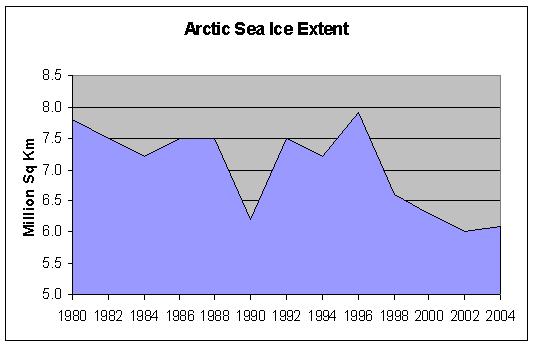
Do read the whole report, which underlines how little even scientists understand what drives the climate. Something I found odd is that the same page also has a graphic on Arctic sea ice extent, which is entitled: "Arctic Ice in Retreat." The data in the graphic plots as follows:

I do think the title is somewhat gratuitously misrepresenting the data... not to mention that the time frame is vanishingly small. Anyway, here (scroll down) is some more information about what is happening to glaciers in general.

Thursday, June 01, 2006

Lomborg is winning, thankfully

I became aware of the Johann Hari and Scott Burgess debate (which IMHO Scott is winning hands down) through the excellent EnviroSpin Watch. Some people where I work are fans of Harry's Place (which I enjoy as well), and came to the same debate through this post. After reading through it they came to the flabbergasting conclusion that Lomborg is misrepresenting himself. Huh?! It's funny how people who make the heritage of the Enlightenment their own, seem to have such trouble accepting hard facts, i.e. that Hari is clearly misrepresenting reality, Lomborg's positions and much else besides.
Anyway, as Philip points out, thankfully Lomborg etc. are clearly winning the practical debate:
Yet, despite the vitriol and abuse, in the solid world, beyond the febrile and hysterical rantings of a few (surprisingly few, I might add) European 'Greens', and some of the 'liberal' media, like The Independent, BBC television (far less BBC radio), and Channel 4, Lomborg is quietly winning the debate.
As Canada's The National Post (May 30) points out in 'Ottawa's Kyoto plan wins backers in Bonn', the Kyoto Protocol is slowly and inexorably being ditched and abandoned.
[...]
The economic imperative, coupled with dynamic adaptive innovation, will continue to thrive. Lomborg, in essence, has won. Hence the ill-tempered outbursts of Mr. Hari and his ilk. Sadly, in the meantime, such people have caused us to waste so much energy on sheer fantasies. As Lomborg says, we should be concentrating on getting the best outcomes for our money, especially for the poorest and the most disadvantaged in the world.
Do read the whole thing. Unfortunately Hari etc. seem intent on proving that they are totally unhinged from reality, which is a pity.